Building climate resilience

Related links
Read the full 2025 Responsible Investment Report
The global real estate sector sits at the centre of the climate challenge, accounting for 32% of global energy consumption and 34% of carbon dioxide emissions, according to the Global Status Report1 published by the United Nations Environment Programme (UNEP). In this context, rigorous sustainability evaluation is not optional; it is an operational imperative for investors seeking resilience, transparency, and long term value creation.
Against that backdrop, our partner fund manager, Resolution Capital, focuses on how progress is measured, evidenced, and accelerated within the Nedgroup Investments Global Property Fund (portfolio). The portfolio relies on three complementary lenses to evaluate performance and transition readiness: Global Real Estate Sustainability Benchmark (GRESB) scores², the Net Zero Investment Framework (NZIF)³, and detailed carbon metrics. GRESB is the industry’s most recognised Environmental, Social and Governance (ESG) benchmark for property, assessing companies on a 0–100 scale across ESG pillars, while also evaluating disclosure quality and benchmark coverage. These features allow for consistent cross‑market comparisons and help explain differences where reporting adoption is still developing.
GRESB: Demonstrating strong ESG fundamentals across the portfolio
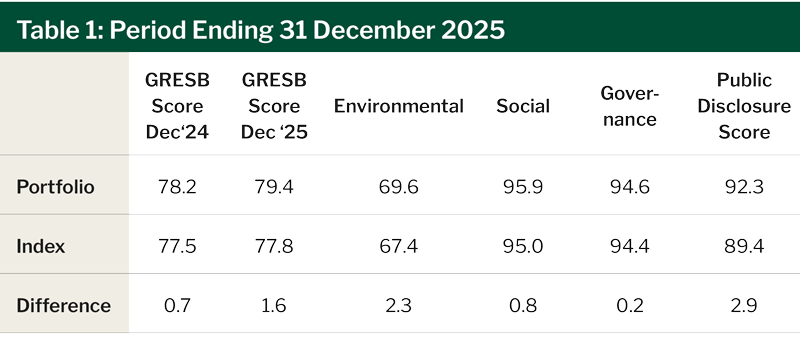
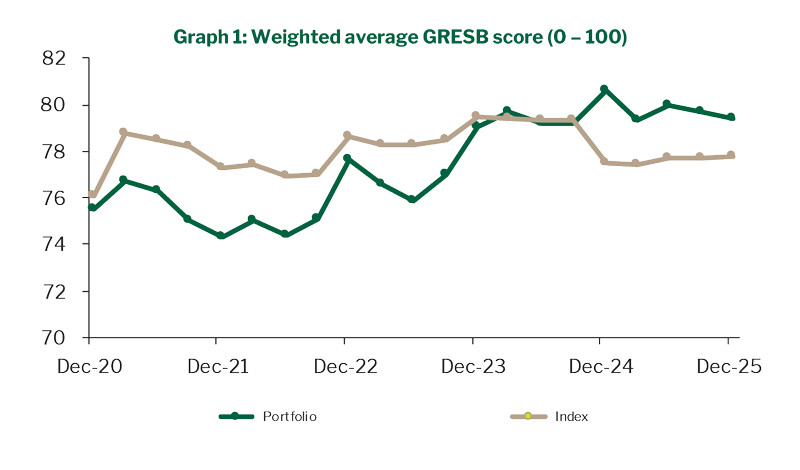
Within this framework, the portfolio’s weighted‑average GRESB score reached 79.4 at 31 December 2025, compared with the benchmark’s 77.8, extending the advantage maintained since 2024. The portfolio’s Public Disclosure Score of 92.3 also exceeded the index’s 89.4, indicating stronger transparency and data quality across our holdings. These results reflect broad‑based strength across the ESG pillars rather than reliance on a single factor.
Source: Resolution Capital, GRESB, 31 December 2025
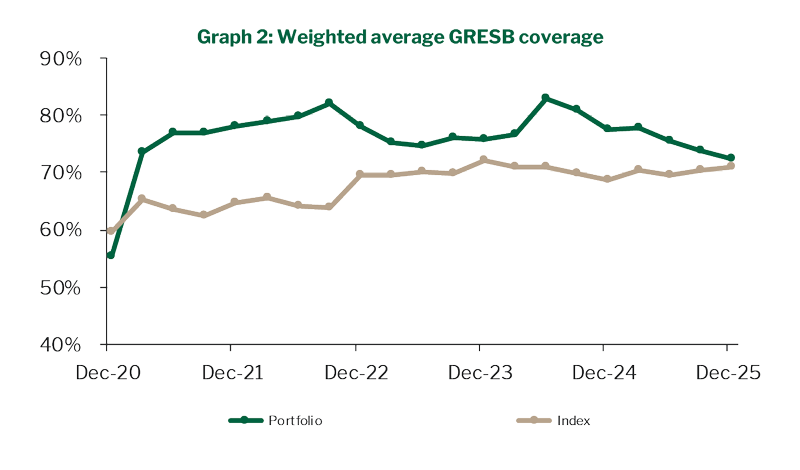
Coverage remains important for decision usefulness. With 72.4% of portfolio holdings reporting into GRESB, above the index’s 70.9%, the portfolio benefits from a richer evidentiary base. Higher coverage provides more reliable insights into environmental performance. Resolution Capital continues to prioritise engagement with holdings that do not yet report to GRESB, encouraging adoption of the benchmark as an industry standard for ESG assessment.
Source: Resolution Capital, GRESB, 31 December 2025
Portfolio‑level leadership is reinforced by company‑specific improvements observed during the assessment cycle. Big Yellow Group, Simon Property Group, and Urban Edge each increased their GRESB scores by more than five per cent during the year, driven by expanded green‑building certification coverage. With Big Yellow Group and Simon Property Group also enhancing their data monitoring, as well as energy, water and waste intensities. These operational improvements translate directly into higher, independently assessed scores and demonstrate meaningful transition momentum at the asset and platform levels.
Net zero investment framework: Evaluating climate alignment and transition readiness
Where GRESB reflects current ESG quality, the NZIF offers a forward‑looking assessment of climate alignment and transition readiness. The NZIF evaluates six elements:
1. A commitment to being net-zero carbon emissions by 2050
2. A short- or medium- term carbon reduction target in line with the Paris Agreement, i.e. targets that are in line with a 50% reduction in carbon emissions by 2030
3. Actual carbon emissions reductions in line with this target over a rolling five-year period
4. Disclosure of Scope 1, 2 and 3 emissions
5. Publicly disclosed decarbonisation strategy
6. A capital allocation plan that shows how a net zero target will be resourced and achieved
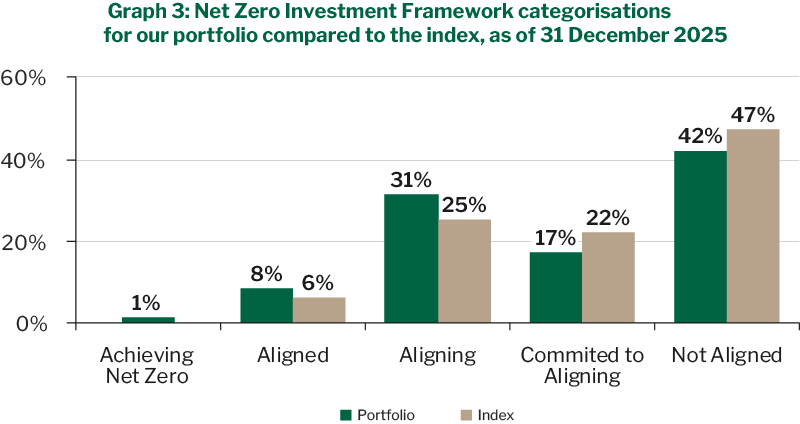
Based on these criteria, companies are classified into categories ranging from Not Aligned to Achieving Net Zero. As of 31 December 2025, our portfolio shows a stronger NZIF alignment profile than the index, with higher representation in the Aligning and Aligned categories, and a small exposure to Achieving Net Zero that the benchmark lacks. This distribution supports the view that our holdings are better positioned for policy tightening, evolving customer expectations, and emerging technologies that will shape the real estate sector over the next decade. These classifications also guide our engagement priorities, focusing on companies at earlier stages of alignment to support progress toward achieving net zero emissions by 2050.
Source: MSCI ESG Research, Resolution Capital, Corporate Disclosures, 31 December 2025 | Index: FTSE EPRA NAREIT Developed Index
Carbon emissions: Understanding efficiency in an energy intensive sector
Carbon performance remains central in an energy‑intensive sector. Resolution Capital therefore measures emissions in the portfolio through two complementary indicators to capture both economic and physical efficiency: emissions per unit of revenue (tons CO₂ per US$1 million of revenue) and emissions per square metre of building area (kg CO₂/m²). This dual lens helps distinguish between companies that generate stronger economic returns per unit of emissions and those that operate their buildings more efficiently.
1. Revenue-based carbon intensity
As at December 2025, the portfolio produced fewer tons of CO2 per US$1 million in revenue than the benchmark, and its intensity declined from 137 to 134 over the quarter, while the index remained unchanged at 191. While the portfolio’s carbon intensity on a revenue basis remains below that of the index, the area‑based carbon intensity of the portfolio continues to be above that of the ndex (see graph 4).
2. Area-based carbon intensity
Area based intensity reflects sector composition as well as operations. Data Centres & Towers are among the most carbon intensive property types in our dataset, with emissions almost doubling from 564 kg CO2/m² in December 2024 to 1,099 kg CO2/m² in December 2025, while other sectors are materially lower, Retail at 77, Healthcare at 50, Industrial at 21 and Self-Storage at 4. Our portfolio maintains overweights in lower intensity sectors such as healthcare and retail, and adjustments through 2025, including increased positions in Prologis, Terreno and Big Yellow Group and new positions in Segro, Avalon Bay and Macerich, supported improvement in overall carbon performance during the year (see graph 5).
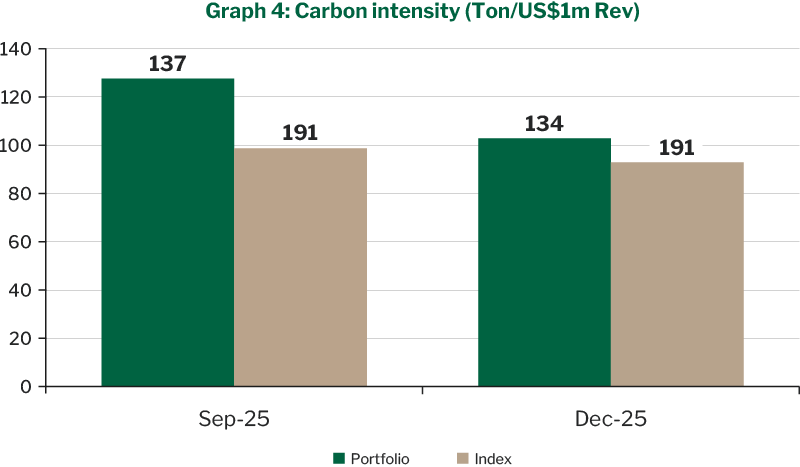
Source: Resolution Capital, GRESB, Bloomberg, company disclosure, 31 December 2025 | Index: FTSE EPRA NAREIT Developed Index
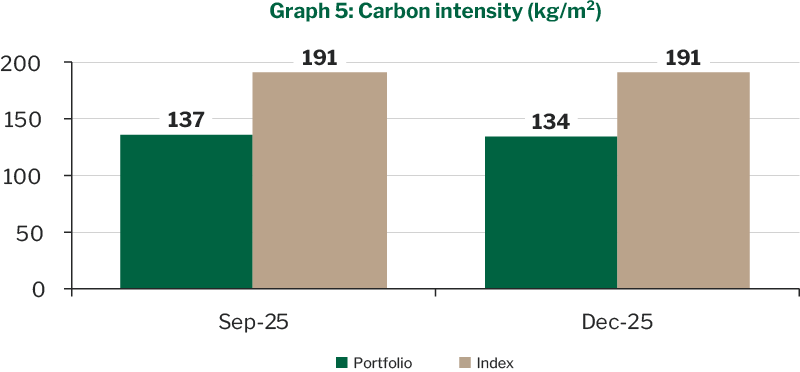
Source: Resolution Capital, GRESB, Bloomberg, company disclosure, 31 December 2025 | Index: FTSE EPRA NAREIT Developed Index
Looking ahead
Nedgroup Investments, together with our partner fund manager, Resolution Capital, will continue to monitor global policy and construction developments that support the transition already evident across the portfolio, including UNEP’s emphasis on stronger building energy codes. These remain uneven worldwide and reinforce the value of advanced disclosure standards and rising GRESB performance visible in the holdings. Progress in low‑carbon and circular construction materials will also be tracked, an area aligned with NZIF expectations and increasingly reflected in company reporting, alongside emerging design approaches that reduce operational and embodied emissions across global supply chains. Finally, growing investment momentum behind efficient and climate‑resilient buildings will continue to be followed, supporting stronger disclosure quality, wider GRESB coverage, improving carbon efficiency and increasing NZIF alignment, and ensuring the portfolio remains positioned for long‑term value creation in a sector undergoing structural decarbonisation.


