Every basis point has a source

Related links
Navigating change in South Africa’s money markets: What ZARONIA and FLAC mean for investors
For corporate treasurers, cash has never been more important than before. In an environment where surplus liquidity can make a meaningful contribution to earnings, even a modest increase in return can appear attractive.
As a result, many investors are looking beyond traditional money market solutions in search of additional yield. Whether through enhanced cash strategies, longer-duration instruments or broader opportunity sets, the pursuit of higher returns has become more common.
Yet one important question is often overlooked: Where is that additional yield coming from?
Every basis point has a source. Understanding that source often tells investors far more about a portfolio than the yield itself.
To understand why this question is becoming increasingly important, it is useful to consider how South Africa's money market is evolving.
An evolving opportunity set
South Africa’s money market is undergoing significant change. The transition from the Johannesburg Interbank Average Rate (JIBAR) to South African Rand Overnight Index Average (ZARONIA) is reshaping the pricing of floating-rate instruments, while the introduction of First Loss After Capital (FLAC) instruments is creating a new layer within banks’ funding structures.
Unlike JIBAR, which is based on quoted rates, ZARONIA is calculated from actual overnight transactions. FLAC instruments, meanwhile, sit below senior debt in a bank's creditor hierarchy and form part of its loss-absorbing capacity. Investors in FLAC therefore assume additional structural and loss-absorption risk.
These developments are broadening the opportunity set available to active managers, but they also make it increasingly important to understand the risks underlying portfolio returns. We explored the implications of both developments in more detail in our previous article, Navigating Change in South Africa's Money Markets: What ZARONIA and FLAC Mean for Investors.
Where does the extra yield come from?
Additional yield is generally earned by accepting an additional form of risk.
A manager may extend duration by investing in longer-dated securities to capture a higher term premium. However, this can introduce greater capital volatility and reduce short-term liquidity if cash is required unexpectedly.
Additional yield may also come from investing in less liquid securities. These instruments may offer attractive returns during normal market conditions but become materially harder to sell during periods of market stress. During the COVID-19 market disruption, liquidity became a key differentiator, with bank-issued negotiable certificates of deposit remaining among the more readily tradable fixed-income instruments despite offering lower yields.
Another source is credit and structural risk. Investors may move further down a bank's capital structure into instruments such as FLAC, Tier 2 or Additional Tier 1 (AT1) debt. These instruments should offer higher spreads because investors rank below senior creditors and absorb losses earlier in a stress or resolution scenario.
Therefore, the important question is not only whether additional yield is available, but whether the additional spread adequately compensates investors for the additional risk.
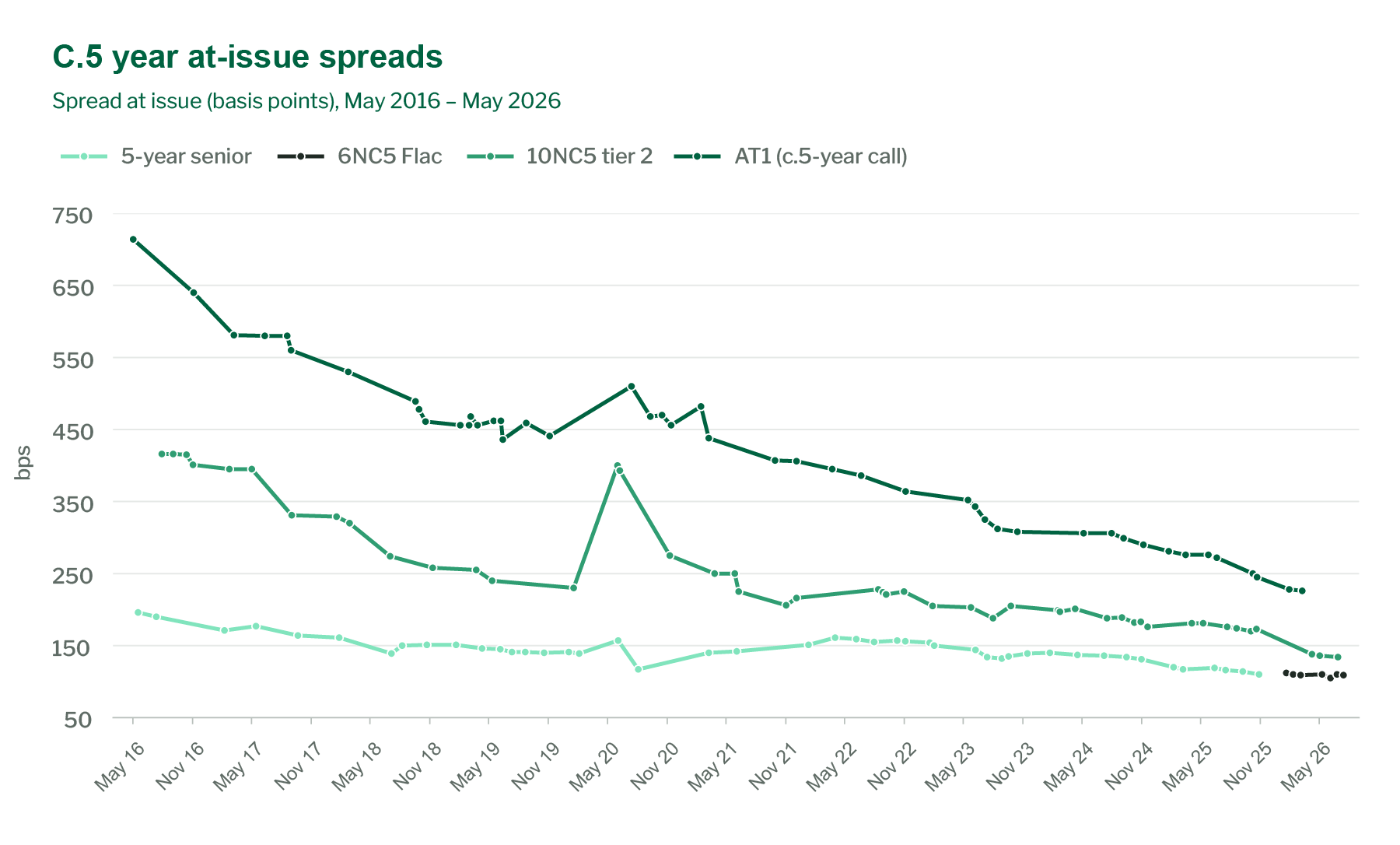
The chart below illustrates this trade-off. In May 2016, five-year senior debt was issued at a spread of approximately 190 basis points, compared with around 420 basis points for Tier 2 debt and more than 700 basis points for AT1 instruments. Investors were therefore receiving a substantial additional spread for moving lower down the capital structure and accepting greater loss-absorption risk.
At the latest levels shown on the chart, senior debt is priced at approximately 110 basis points, compared with around 140 basis points for Tier 2 debt and approximately 225 basis points for AT1. Although subordinated instruments continue to offer additional yield, the compensation available for taking this additional risk has narrowed materially.
For example, the spread differential between senior debt and Tier 2 debt has declined from approximately 230 basis points in May 2016 to around 30 basis points at the latest levels shown. So investors are accepting materially greater structural risk for a much smaller increase in yield than was previously available.
FLAC provides a particularly relevant example. Due to FLAC sitting below senior debt in the creditor hierarchy, investors should expect additional compensation for its subordination, potential loss absorption and lower liquidity. However, recent FLAC issuance has priced close to senior debt, raising the question of whether the additional spread adequately compensates investors for the additional risks being assumed.
The point is not that subordinated instruments should be avoided. Rather, when spreads compress, the underlying risks do not necessarily disappear. Investors are simply being paid less to accept them.
Figure 1: Five-year at-issue spreads across different levels of bank debt seniority
Source: Standard Bank Research
The true test of a cash portfolio
These trade-offs can be easy to overlook when markets are calm and liquidity is readily available. The true test of a cash portfolio is whether capital remains protected, and liquidity remains available when it is needed most.
Securities that appear attractive during favourable market conditions can behave very differently during periods of uncertainty. Lower liquidity, longer duration and subordinated exposure can all become more consequential when markets are volatile or access to cash becomes critical.
For treasury teams, the objective is not to avoid risk altogether. It is to ensure that the risks taken remain consistent with the role cash is expected to fulfil on the balance sheet and comply with the organisation’s investment or treasury policy.
Conclusion
South Africa's evolving money market continues to provide opportunities to add value through thoughtful security selection and portfolio positioning. Differences in issuer spreads, changing funding requirements, the introduction of FLAC instruments and the continued evolution of the ZARONIA-linked market all create scope for active management.
The highest-yielding fund today may indeed prove to be the best-managed portfolio, or it may simply reflect a different approach to liquidity, duration or credit risk. The yield investors see cannot answer that question.
Understanding where the return comes from, and whether the additional yield adequately compensates for the additional risks being assumed, enables investors to determine whether a strategy remains appropriate for the role their cash is expected to perform.


