What private credit's growing pains reveal about public credit and the value of liquidity

Related links
No related links
With defaults, concentration risk and redemptions rising in private credit, the structural advantages of public fixed income – transparency, flexibility and daily liquidity – are coming back into focus.
From a niche corner of institutional portfolios, private credit has grown into a $3.5 trillion asset class, providing capital to mid-sized borrowers as banks retrenched after the global financial crisis.[1]
Its appeal to institutional investors was obvious: senior-secured exposure, floating-rate income and the promise of an illiquidity premium over public markets. That premium was especially prized when income from bonds was supressed by historically low rates, with investors willing to sacrifice liquidity for yield. More recently, the addition of semi-liquid structures has attracted retail investors, whose participation has risen from zero in 2010 to 13 per cent today.[2]
But the conditions that supported private credit’s growth have changed. Interest rates have normalised, restoring income levels in public fixed income. At the same time, private credit spreads have compressed, and structural protections have eroded as competition for deals has intensified.
This poses a dilemma for investors. Limited transparency, illiquidity and long lock-up periods in private credit were acceptable to long-term investors when rates were near zero. Today, with public bond markets offering competitive returns, the question for investors who value liquidity and transparency is whether the balance of risks and rewards in private credit justifies the compromises it demands.
What the current stress tells us
Recent concerns around private credit are the result of concentrated exposure within parts of the market, particularly US business development companies (listed private credit vehicles).
Across the BDC universe, software exposures average around 20 per cent, with some vehicles holding closer to 50 per cent.[3] Contrast that to US high yield, where software accounts for just three per cent of outstanding debt. It is also worth noting that the quality of the high yield universe has improved significantly in recent years, with 58 per cent of issuers rated BB today, the highest level on record.[4]
When concerns about artificial intelligence disruption began affecting the valuations of software issuers, the repercussions were swift. One US private credit manager halted redemptions on a $1.6 billion evergreen fund after investors rushed to withdraw capital.[5] Others put limits on redemptions after they exceeded the five per cent threshold allowed during quarterly liquidity windows.
The default picture reinforces investor concerns. According to Fitch, the default rate across its portfolio of US privately monitored ratings reached 9.2 per cent in 2025, up from 8.1 per cent the previous year and more than triple the 2.5 per cent recorded in high yield.[6] Among smaller issuers with EBITDA below $25 million, the default rate climbed to 15.8 per cent. For the broader market, UBS strategists have warned that in a severe scenario involving rapid technological disruption, private credit defaults could reach as high as 15 per cent.[7]
While premature to talk of a crisis, experienced credit investors have learned to treat these kinds of early signals seriously. In 2007, stress in the US subprime mortgage-backed securities market appeared contained and idiosyncratic before proving to be neither. Rising defaults are a leading indicator, and not a reassuring one.
Why transparency matters
One of the key characteristics of private credit is the absence of daily mark-to-market pricing. While this shields investors from short-term volatility, it also limits their ability to assess how exposures are performing in real time. And in a stress event, the inability to adjust portfolios may prove more costly than the volatility they are designed to avoid.
As the Federal Reserve noted in a 2024 paper, private credit loans are illiquid by design and investors requiring an early exit should expect significant discounts.[8]
Of course, public bond markets have their own complexities, and liquidity is not a given. However, they provide something private credit cannot replicate – continuous price discovery, observable positioning and the ability to adjust exposures as conditions evolve. Such optionality is underappreciated during periods of market stability but is essential when markets are volatile.
Liquidity and the structure of credit
Higher potential returns in private credit reflect the price of sacrificing liquidity. This trade-off has historically worked in closed-ended vehicles where sophisticated investors commit capital for long periods and redemptions are not a feature.
It becomes more complex when loans are packaged into semi-liquid structures. The weighted average life of US direct lending loans typically runs between three and four years.8 In vehicles offering quarterly liquidity – particularly when redemption requests approach or exceed the standard five per cent cap – it creates a structural mismatch.
It is also worth considering who holds these exposures. Insurers and pension schemes have built significant allocations to private credit in recent years, including through semi-liquid vehicles. If stress intensifies, the transmission mechanism could potentially run through the broader financial system, which is why signals in one part of the credit market deserve attention across the whole.
A matter of scale
Private credit remains small relative to the $145 trillion global fixed income market,[9] where average daily trading volumes exceed $1.5 trillion.[10]
The investable universe spans sovereign and corporate issuers, multiple currencies, and a wide range of maturities and credit ratings across developed and emerging markets. For active managers, that breadth allows for dynamic portfolio construction. They can rotate between investment grade and high yield, adjust duration in response to policy shifts, move between sovereign and corporate exposures and express views across currencies. Flexibility is a key risk management tool.
Private credit strategies, by contrast, are naturally more concentrated. Loans are originated for specific borrowers and typically remain in portfolios until maturity or refinancing. That structure supports stable income streams but offers limited scope for repositioning if conditions change.
Public bond markets also offer yields that were absent during the era of ultra-low interest rates. Investors evaluating credit allocations in this environment may find that actively managed public credit strategies offer a different and, in some respects, more favourable balance of risk and return.
Figure 1: Yields return to US high yield (per cent)
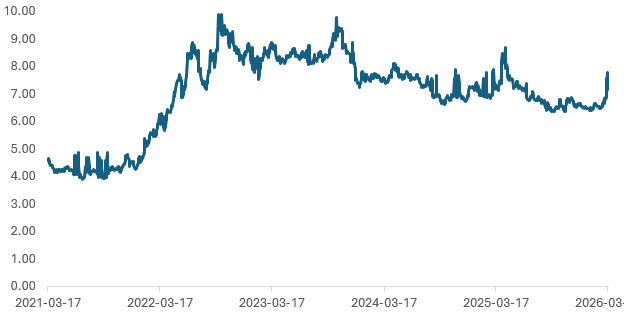
Source: ICE BofA, US High Yield Index Effective Yield, as of March 2026
Recalibration required
Perhaps public and private credit are best understood as complementary parts of the same ecosystem. Each has advantages and constraints. But the value of transparency and liquidity in public bond markets should not be underestimated.
As investors assess their credit allocations at this late stage of the cycle, portfolios may need to be recalibrated accordingly.
Bonds, behaving like bonds, have a key role in that recalibration.
Endnotes
- Alternative Credit Council, Strong growth sees private credit market reach $3.5 trillion, December 2025
- Bank for International Settlements, Retail investors in private credit, July 2025
- Financial Times, Investors sour on listed credit funds over AI hit to software sector, February 2026
- ICE BofA, US High Yield Index, March 2026
- Bloomberg, Private Credit's Gate-Crashers Are Forcing Funds Into a Brutal Spot, March 2026
- Fitch Ratings, US Private Credit Defaults Hit New Highs but Losses Remain Contained, March 2026
- Bloomberg, Private Credit Fears Deepen With UBS Warning of 15% Defaults, March 2026
- Federal Reserve, Private Credit: Characteristics and Risks, February 2024
- Securities Industry and Financial Markets Association, Capital Markets Fact Book, July 2025
- Securities Industry and Financial Markets Association, Research Quarterly 4Q25, January 2026
This article is of a general nature and intended for information purposes only, it is not intended for distribution to any person or entity who is a citizen or resident of any country or other jurisdiction where such distribution, publication or use would be contrary to law or regulation. Whilst all reasonable steps have been taken to ensure that this article is accurate and current at the time of publication, we shall accept no responsibility or liability for any inaccuracies, errors or omissions relating to the information and topics covered in this article. The opinions expressed may be subject to change or amendment at the discretion of the Investment Manager without notice.
Nedgroup Investment (IOM) Limited (reg no 57917C), is licensed by the Isle of Man Financial Services Authority.
Nedgroup Investments (UK) Limited is regulated by the Financial Conduct Authority.


