Keeping more isn't the same as building more

Related links
The psychology of investing: The illusion of a "better time" Start with knowledge: Financial fitness takes time
There is a particular type of financial advice that never disappears: spend less, cut back on coffee or takeaways, avoid unnecessary luxuries and watch the small, miscellaneous expenses. The logic is easy to understand. Spending less than you earn creates financial breathing room, while reducing waste can improve long-term outcomes.
However, many of the discussions about personal finance stop too early. Being careful with money and building wealth are related, but they are not the same thing. Budgeting is fundamentally a tool that helps us understand where money is going, identify unnecessary expenditure and create greater intentionality around spending decisions. Those are valuable outcomes, but budgeting alone does not determine whether long-term wealth is being created.
Long-term wealth creation ultimately depends on allocation – what you do with the money you have saved. That distinction may seem subtle, but it sits at the centre of how successful outcomes are achieved.
Consider two people earning the same income and spending roughly the same amount each month. Both operate within a budget, and both manage their finances responsibly. The difference is that one consistently channels a portion of their surplus into investments, while the other treats any remaining money as available for future spending. Their monthly budgets may look almost identical, yet over time their financial outcomes are likely to diverge significantly. The reason is simple: long-term wealth is influenced by what is done with the surplus once it exists.
This is where financial systems become important. The strongest financial strategies require minimal ongoing negotiation because they are built on repeatable systems that require just one good decision. Automating investment contributions with a debit order and standing decisions about how additional income or bonuses will be allocated all reduce the need for repeated, manual decision-making.
Take Carol and Kevin, for example. Both earn roughly R25,000 per month and, after reviewing their budgets, have made it a priority to cut costs and save R2,000 every month towards their financial future.
Carol sets up a debit order that automatically invests R2,000 into a diversified investment fund shortly after payday. Because the money is invested before it reaches her everyday spending account, she rarely thinks about it, and investing becomes part of her routine.
Kevin also intends to put away R2,000 every month. However, he relies on manually transferring the money into a bank savings account. Most months he succeeds, but every so often unexpected expenses, social events or competing priorities mean he spends more than planned. As a result, every third month he only manages to save R500 instead of the R2,000 he originally intended to put away.
Over 20 years, the difference between the two approaches becomes significant. Assuming Carol’s investment earns 12% per year, her consistent monthly contributions grow to approximately R2 million. Kevin, meanwhile, contributes less than planned over time and keeps his money in a bank account earning 6% per year. Although he remains committed to saving, his balance grows to approximately R700,000.
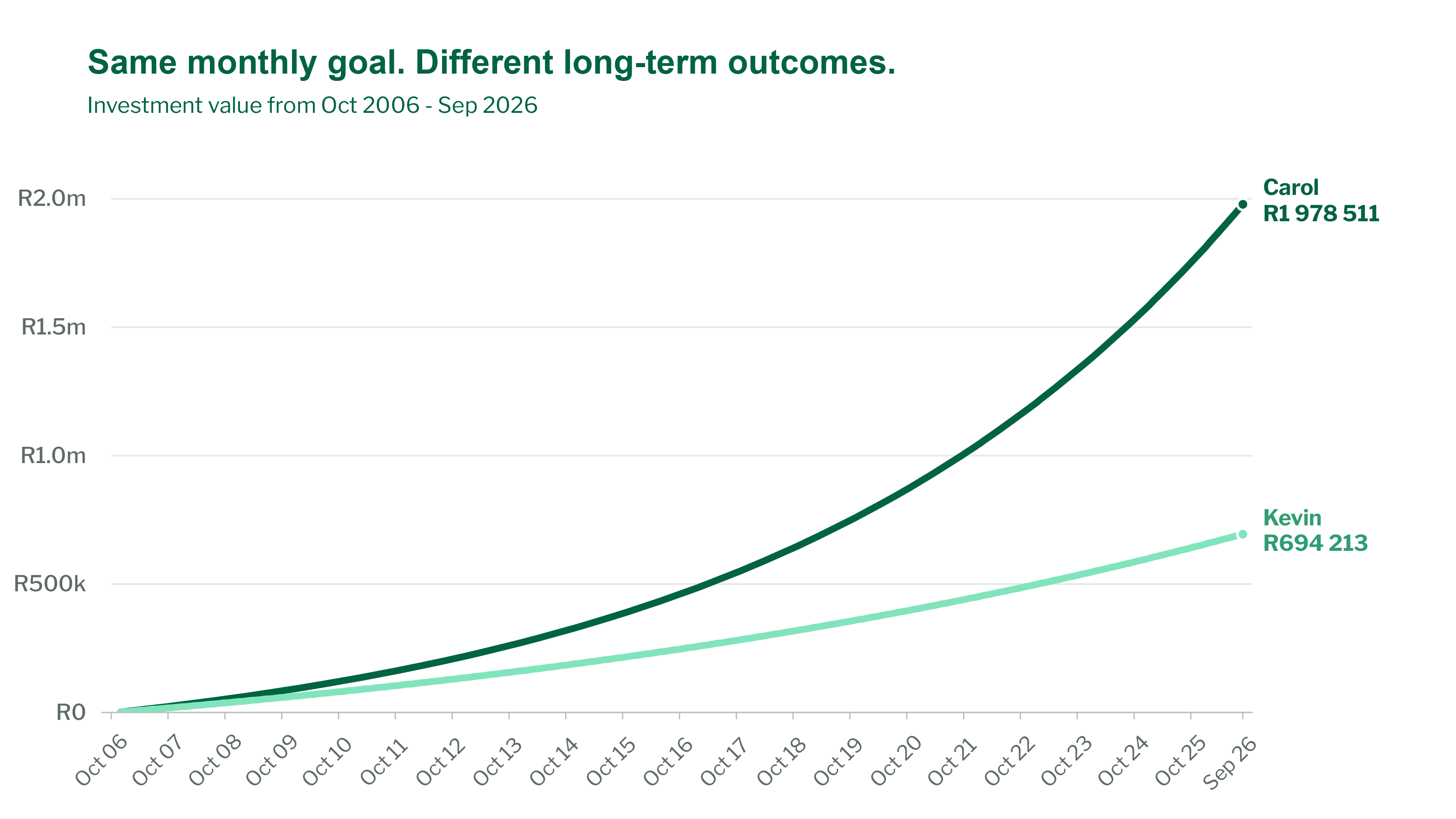
Source: Nedgroup Investments. Carol’s calculation is based on a 12% return pa which is representative of the typical long-term returns of a well-diversified equity fund and Kevin’s calculation is based on a 6% return pa in a bank savings account.
What makes these systems powerful is not their sophistication but their repeatability. A decision that requires your input and willpower every time carries an opportunity for delay, distraction or competing priorities, and systems reduce that friction. Rather than relying on a monthly decision about whether investing should take place, they establish investing as the default outcome. In behavioural terms, they automate the desired action.
A person who invests steadily over many years will typically benefit far more than someone who repeatedly looks for opportunities to save money but never develops a reliable mechanism for converting those savings into assets.
This is not an argument against budgeting. Budgeting remains one of the most useful financial tools available. It creates awareness, improves decision-making and helps identify opportunities to deploy capital more effectively but it should be viewed as the beginning of the process, not the end. After budgeting, focus on whether that money is being directed towards something capable of growing beyond today's budget.


