The illusion of a "better time"

Related links
The psychology of investing: Keeping more isn't the same as building more Start with knowledge: Why starting early matters
Most people do not delay investing because they do not understand how important it is. They wait because they believe the future version of their life will be better equipped to begin.
Retirement planning, long-term investing and the value of starting early are familiar messages. Many adults have heard them through workplace retirement funds, financial media or conversations with advisers. Yet knowing what matters is not always enough to prompt action.
Instead, the decision to delay is frequently driven by the belief that circumstances will be more favourable later. People tell themselves they will start once they earn more, once certain debts are paid off, the markets feel calmer, or when life becomes more predictable. The specifics vary, but the underlying assumption is the same: there will be a better time to begin.
It is an understandable way of thinking. Financial decisions do not happen in isolation; they compete with the realities of day-to-day life. When budgets are under pressure, immediate priorities naturally take precedence over long-term goals. The difficulty is that life doesn’t always become as financially simple as we imagine it will.
Higher income is often accompanied by higher expenses. Career progression can bring new financial responsibilities. Uncertainty in markets is replaced by a different source of uncertainty, and one milestone gives way to the next. Rather than creating a clear opening for financial decisions, life events just continue to compete for attention.
This is what makes investing different from many other financial decisions - it requires action despite uncertainty, not after uncertainty has disappeared.
Uncertainty is not a temporary hurdle that investors eventually move beyond, but a part of the investment environment. Markets will always move, personal circumstances will always change, and competing priorities will always exist. This is why waiting for certainty can become so costly: the conditions we are waiting for may never fully arrive.
Behavioural finance helps explain why this happens. Immediate needs are visible and tangible, while future benefits can feel distant and abstract. A current bill, a market headline or a near-term expense feels more urgent than a decision whose benefits will only become clear years from now. The future self is easy to prioritise in theory, but harder to act for in the present.
When investors think about risk, they often focus on choosing the wrong fund, entering the market at the wrong time, or enduring a period of poor performance. These are valid concerns, but they can obscure a quieter risk: not acting at all. Starting small, for example through a debit order, gives investors room to learn early, when the amount invested is still modest and the consequences of any missteps are easier to manage.
Time, unlike market movements, cannot be recovered. Each year spent waiting is a year that cannot be regained. Waiting may feel safe because nothing seems to go wrong in the moment, but the opportunity cost accumulates quietly over time. This should not discourage anyone who has not yet started investing — it is never too late to begin. Whether you are in your twenties, thirties, forties or fifties, starting sooner gives your money more time to grow and may reduce the amount you need to contribute later.
Take Luke and Amy for instance. At 25, Luke lands his first job as an accountant. He isn't wealthy. He shares accommodation, watches his spending and, like many young professionals, has competing priorities for every rand he earns. Still, he decides to start investing R1 000 per month. His goal is to start early for financial freedom later. After 10 years, at age 35, life becomes busier. There is a home to furnish, children to raise, holidays to save for and countless other demands on his income. So Luke stops contributing, but he leaves his investment untouched and lets time do the heavy lifting.
Meanwhile, Amy, also dreams about financial freedom. She is currently an HR manager and wants to climb the corporate ladder. She enjoys traveling and is focused on upgrading her lifestyle. She plans to start investing when she has more disposable income, but 10 years pass surprisingly quickly. At 35, Amy finally gets the promotion to HR executive that she had hoped for and starts investing in earnest. She invests R1 000 per month.
Luke and Amy are both invested in a well-diversified equity fund, assuming a 12% return per annum, and by age 65, the difference between their choices is staggering. Luke contributed R120 000 over his first ten working years. Those early contributions had decades to grow and compound, eventually becoming roughly R6.6 million. On the other hand, Amy started a decade later and contributed R360 000 over three decades. She put away three times the amount that Luke did, yet her investment is only worth R3.1 million at age 65. If she wanted to reach the same amount as Lebo at age 65, she would need to contribute nearly R2 200 per month for three decades.
Comparison of Luke and Amy’s investment over time:
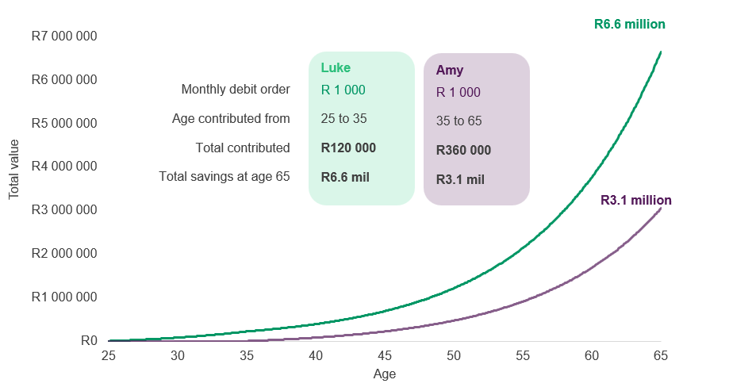
Source: Nedgroup Investments, based on a 12% return pa which is representative of the typical long-term returns of a well-diversified equity fund
The above graphic illustrates the hidden cost of delaying an investment decision. We may think that waiting means missing 10 years of returns but in reality, it means losing 10 years of compounding that could have continued working for the next three decades.
This does not mean every person should invest immediately regardless of their circumstances. Financial realities differ, and there are periods in life when other priorities must understandably take precedence. However, it is worth examining the assumptions that sit behind financial procrastination.
When someone says they are waiting for a better time to invest, what exactly are they waiting for? More income? Greater confidence? More certainty about markets? Fewer expenses? And perhaps more importantly, is there any guarantee that those conditions will ever arrive all at once?
While understanding financial products is important, the psychology of investing also requires us to understand ourselves and the stories we tell about the future, the comfort we find in delay, and the belief that tomorrow will make today’s decisions easier.


